Monday, July 5, 2010

World Cup Fever

It was amazing! Being surrounded by rabid avid crazed soccer fans who are decked out in wacky costumes and chanting along with drums and vuvuzelas is a goosebump inducing experience. I felt quite underdressed with my two intertwined USA and Argentina scarves. My adopted team got crushed but it was still an awesome game and I have to admit that Germany (with their Polish players) played extremely well. Great atmosphere but I wish I could have seen the USA Algeria game! Donovan is my hero. Here are some pictures from my first world cup (I say first, because, for something this awesome I will obviously have to attend again. Anyone want to go to Brazil in 2014?) :


Notice the Argentinian fairy and aviators


Pregame parade


Los locos


Juggling at the stadium


The flags come onto the field


Germany in black and Argentina in white

First half: Argentina plan their free kick


Second half about to start


Zakumi the mascot

Some disappointed Argentina fans agreed to snap one last juggling shot

Wednesday, June 30, 2010

Threshing Thresholds

Last week I got a surprise. The principal organized a thank you ceremony to show appreciation for the work I've done fixing up the library. All the learners were lined up outside the library and she told them in oshiwambo ('so that each and every learner can get what I am saying') that she had some gifts for me for the 'good good job' that I did. She had asked me earlier to give her a picture of myself and I was kinda suspicious something was up. It turns out that she wanted the photo so she could print it on a shirt. On the front it says, Mr: Parker Lewis captioning my semi-blurry enlarged picture, and on the back it has a message about the improvement of the school library and how they will 'aways remember me and never forget.' I also got a certificate and a big container of omashuku (nuts from the marula fruits).


Meme Principal showing off my new shirt


You can see my picture on the shirt and the big container of omashuku - I joked with the learners that now I can watch them with four eyes


The learners lined up in their classes


Susana and Ester playing checkers; Gertrude and Helvi enjoying some literature; And look at all those books on the nice new shelves I bought with your generous donations!


Justina and Alina working a couple puzzles


And here are some more pictures from the homestead. After all the millet is gathered from the fields, they pile it up in the oshipale which is the place where they thresh the grain from the stalks. Some stems are raked out to the middle and they just start wailing on it with old palm tree branches. After it's separated then they sweep it up into the ever growing pile of threshed grain. When it is all beaten, they then have to sift out the unwanted parts and it is stored in one of the few huge grain baskets they have within the homestead. The threshing took about two weeks of sporadic work and all the while trying to shoo off the marauding birds.

Corn cobs, ground nuts, and millet


Meme and Tillie observing the millet pile


Mwingona and Niita midthresh


See the grains fly


Homestead in the background


Meme with headwrap, corn, and cell phone pouch


The pile post-threshing


Saturday, June 5, 2010

The first term ended at the end of April and I was very ready for the upcoming month long vacation. Before traveling around Africa, I attended Camp GLOW with five of my learners. GLOW is another Peace Corps sponsored camp much like the Diversity Tour I wrote about last year. Peace Corps Volunteers across Namibia had some of their best and brightest learners apply, and a total of 80 kids, ranging from grade six up to twelve, made the trip to Windhoek for a week full of activities. Each day covered a different topic which included: team building, HIV/AIDS, character building and self esteem, careers and future, gender, and leadership. Some of the highlights include a trip to the Namibian Parliament, a tour of Polytechnic Institute of Namibia, presentations from various professionals (pilot, chiropractor, firefighter, geologist, veterinarian, entrepreneur), and a visit to the cinemas where we watched a cool animated movie about Vikings and dragons. The kids had a great time and I was so impressed by their personalities, ambition, humor, and overall intelligence.


Me with my learners at Camp GLOW (Asser, Lusia, Aina, Rautia, and Leta)


The night of the dance party (Rautia, Asser, Lusia, Leta, and Aina)
Epupa at dawn

After that wonderful but exhausting week, I met up with my buddies Greg and Nate and we set off to Opuwo in Northwest Namibia. This area of the country is home to the Himba people who have a very distinctive style and are seen on almost every guide book cover. Opuwo (which means ‘finished’ or ‘the end’) is also the gateway to the much hyped Epupa waterfall. Our plan was to follow the river, and walk from Epupa until we reached the next waterfall called Ruacana, a distance (we were told) of 100km. We stayed for a night in Opuwo with some friends who had hiked it the previous year, and then left early the next morning to try and make it to Epupa. At the edge of town, the tarred road ends and the gravel road starts and we quickly (in Namibia that means after a few hours) found a ride for N$50 to the next ‘town’ along the way, Okangwati. Then came the real wait. The farther away from Opuwo, which is by no means largely populated, the roads and towns become smaller, quieter, emptier, and more and more remote. So in Okangwati we got dropped off on the dirt road under a nice shady tree and saw less than 10 people the whole rest of the day. For about 7 hours we sat around waiting for a ride and not one car passed. As the sun sank lower and lower, we decided to cook up some lentils for dinner, prepared to set up our tents and settle down, resigned that we would just have to try again tomorrow. But out of nowhere, a truck half full of Himba villagers and corn cobs pulls up and says they’ll take us to Epupa. So we piled in and drove off into the sunset eating our dinners and enjoying sundowner beers while watching the Himba kids herding their livestock home for the night. It was quite a unique day.

We arrived to the small town of Epupa (a collection of tourist lodges and scattered houses) and were graciously allowed to set up our tents in the yard of our driver. In the morning, we caught the sunrise at the edge of the waterfall, which was beautiful, but to be honest, a bit of a letdown after all the hype. So we packed up all our bags and started walking along the dirt road following the river upstream. About midday, our heavy packs were beginning to wear on us, and already some blisters were starting to develop from our infrequently used hiking shoes. It was then that we decided to buy a donkey. We had been joking about the idea before but never gave it serious consideration. We happened to meet a learner traveling home to his village and he directed us to a small riverside collection of shops where he said someone might be willing to sell us a donkey. We bought some ice cold sodas and made some inquiries. The shopkeeper could speak fairly good English but the rest of the villagers were Himbas who speak Oshiherero. So we discussed the matter for a bit but for a while they thought we wanted to hire the donkey along with a guide to take us up to Ruacana. I finally said in Oshiwambo, “Otwa hala okulanda ondongili” (we want to buy a donkey) and the chorus of ‘ohhhhhs’ meant that they finally understood. After that I figured that my Oshiwambo was somehow good enough to communicate with Oshiherero speaking people due to the similarities between the two languages. So we forked over N$500, loaded up two of our bags (the third we took turns carrying), and led our new donkey away by his improvised rope bit. We named him Olaf and he was our companion for the next five days.

Now accompanied by our equine friend, we traveled easier and were able to take in the amazing landscapes as the river wound its way through a mix of terrain as rocky hills gave way to palm trees, and grasslands blended with mopani scrub forests. For five nights and six days we marveled at our remoteness, soaked in the serenity of nature, and wondered how the Himba people still manage to live their traditional lifestyle out in the middle of nowhere. Each morning we would rise with the sun, cook up some oats, pack up our bags, and saddle up Olaf. Then we would walk along the trail stopping at our leisure for photo shoots, snack breaks, the odd conversation with locals, or for anything that struck our fancy. Each night we would find a nice camping spot by the river, unburden Olaf, tie him up to graze, hurriedly take a bath in the river while watching our for crocs and hippos, make a fire, cook up some grub, and hit the hay. There were many memorable moments. One evening Nate had inadvertently taken the wrong fork and we were separated. It was getting dark and luckily a Himba dude comes walking down the path with his cattle so I have a successful conversation with him, me speaking Oshiwambo, and him speaking Oshiherero. Mr. Himba told me that the other white guy had taken the other path up the mountain and then he drew me a map in the sand showing where the paths diverged and then reconnected and told us where we could meet up with our lost comrade. We backtracked for a few minutes and sure enough that’s where we found him, so we thanked the cattle herder and he went on his way.

Another day as we were breaking for a snack, we met four small Himba kids on the path. We took the opportunity for some photos and I showed them some juggling with the smooth river rocks which they immediately tried to imitate. As we drew closer to Ruacana, what to do with Olaf was the question at hand. He had certainly helped us carry our load thus far, and had been a pretty good donkey overall, but he had certainly had his upsides and downsides. None of us knew much about tying cargo on pack animals and several times a day we had to stop and fix the bags because they had shifted or fallen off completely. He got spooked a few times and Greg and I ended up with a few scrapes from being pulled through the brush as he raced away. If we weren’t constantly walking next to and behind him, he had the tendency to gradually slow down to the slowest of walks. By the fifth day, we figured that we had bought the oldest slowest donkey and that he was just plum tuckered out. So we began looking for someone to sell him to, and what do you know, we happen across a couple of teachers who speak perfect English and were driving out to a campsite they are building. They agreed to buy him for N$200 and then asked us for the papers. It turns out that when buying any sort of animal in Namibia, you need the proper documents signed by the owners, the buyers, and the village headman, so it’s possible that we were walking this whole time with an illegitimate and possibly stolen donkey! But they consented to our ignorance and led Olaf off to new pastures.

We weren’t quite sure how much further we had to go because our map wasn’t very accurate or detailed, so we just kept walking. At dusk, we happened upon a bunch of people clearly getting ready for something. So we ask if we could set up camp there, and they tell us that it’s a mobile church and that tonight they are going to be showing a movie! They had a projector and screen all set up and screened an old ‘70s movie about the story of Jesus which was dubbed into Oshiherero. So after bathing in the river (while our new friends threw rocks in the water to scare off crocodiles), we sat with a whole crowd of Himbas way out in the bush, watching this movie under the stars with intermissions for singing and dancing.

The next morning, the trail turned away from the river so we just powered through at our fastest pace yet and after a few particularly tall rocky steep hills, we sighted Ruacana falls in the distance. It was still another few hours but we eventually arrived and reveled in the misty air and soaked our tired bodies in a sheltered pool at the base. The total distance ended up being 150km (about 90 miles) which was significantly more than the original 100km and we felt quite accomplished that we had done it, even with the help of Olaf. We wanted to get to Outapi (another couple hours away by car) and serendipity was on our side once again. The parking lot was deserted but as we were getting ready to walk down to the main road, a family pulls up, looks at the falls for a few minutes, and offers us a ride all the way to town. We celebrated with pizza and drinks and began preparing for our next adventure.

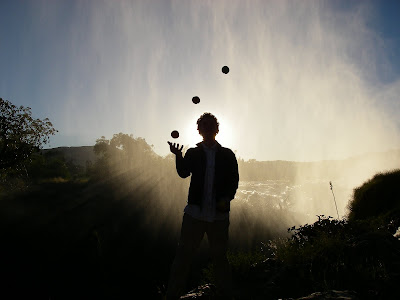
Juggling in the Epupa mist

A river runs through it


Nate and Olaf with me leading the way


Buying Olaf


Juggling with the Himba kids

Coming down from the hills


A Himba lady shows us where we can stay


Maybe my best juggling picture yet

We hitchhiked down to Windhoek and then into Botswana and made our way up to Old Bridge Backpackers in the town of Maun, near the Okavango Delta. After crossing the border into Botswana, we were riding with a nice guy who was driving us to the town of Ghanzi, and all of a sudden the wheel of the car just falls off! We were going about 70 mph and sparks were flying and our insides were in our throats but he was able to hold on and we skidded to a halt. We helped him to fix the tire and then we slowly made it to Ghanzi and he kindly let us sleep at his house on the couches. The next day we caught a legitimate bus to Maun and it was very safe. The delta is amazing. The river just empties straight into the land and the water piles up and makes Namibia look even more like a desert. The water varies from 2 to 6 feet deep and we sat back and floated around in the abundant water in mokoros (traditional Botswanan canoes carved from tree trunks). For three days, through the reeds and between the islands, our two guides steered the mokoros around with long poles while telling us about the trees and wildlife. Unfortunately, we didn’t see many creatures besides spiders, frogs, and birds. But it was a nice relaxing time and much less intense than our last week.

We still weren’t finished with our wanderings. After we hitchhiked back from Botswana we traveled up to the Waterberg Plateau. It’s a very strange earth formation as a massive plateau rises from the completely flat land with rocky cliffs lining the edges. For four days we tramped around on top of the plateau, climbed rocks, made bonfires, and completed the 42km trail. Again, we didn’t see many animals but we did see a roan (maybe a sable), a few klipspringers, a dead eland, and we tracked some squabbling baboons through the bush. The views were incredible and we were completely alone. Not one single other human on that rock besides us three. It was pretty great. I haven’t been able to get the pictures from Greg and Nate so stay tuned to their blogs (Greg’s: http://greginnamibia.blogspot.com/ and Nate’s: http://natebloss.blogspot.com/)

A critter from Waterberg

Alright that’s it for now. More photos to come. World Cup is upon us and a trip to Cape Town for the quarterfinals is in the works! Hope it pans out!!

Peace, Parker

Saturday, May 29, 2010

Creepy Crawlers

There are almost two months to recap so here goes...

After the snake incident I was very wary for a while but thankfully there have been no more reptilian encounters. The bats in the toilet, however, are another issue. Every time I go to sit down on the pot, the squeaking and fluttering of wings sends shivers of apprehension coursing through my body because I really don’t want bats flying up my bum. A fellow volunteer friend described his experience with a bat that did just that, and it surely would be memorable but not necessarily a memory I would want to have.

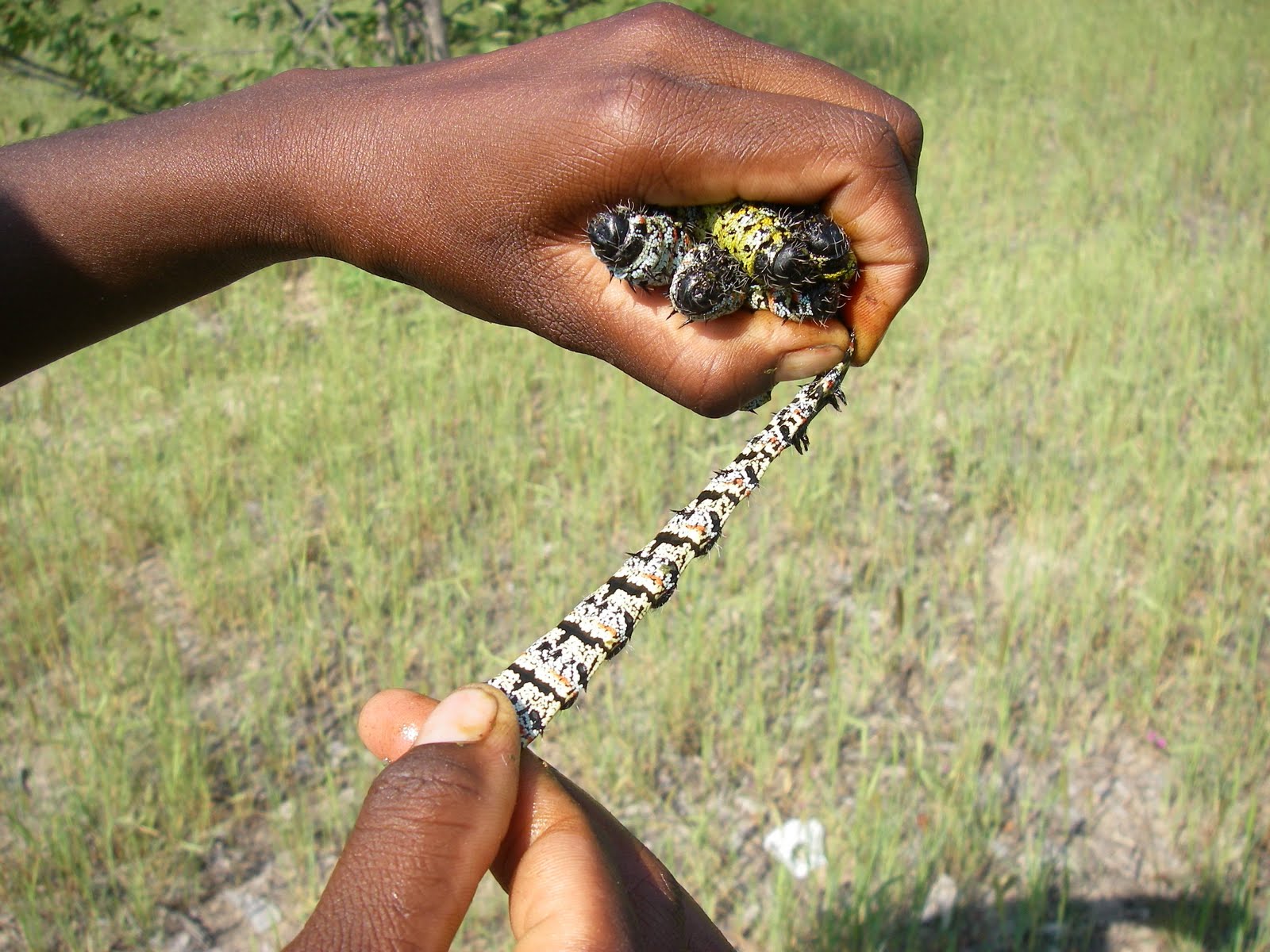
The interactions with wild creepy crawlies do not stop there. Skinks and geckoes hide in the cracks, spiders scurry up the walls, and every so often there will be a giant ongongololo (millipede) undulating its way around the homestead. And during the end of the rainy season, the Mopani trees are rife with omagungu (caterpillars) chomping away at the distinctively angel-wing-shaped leaves. The appearance of these finger-long spiny creatures is a huge deal for the Owambo people. For the whole of March and April, Meme Emilia and the kids were out in the bush veld every day harvesting the delectable ‘worms’ as they are called. The caterpillars don’t have eyes and just blindly munch their way through the leaves, leaving swathes of bare trees in their wake. But it’s a good thing because the caterpillars grow incredibly fast and that means more good eats for the people.

It’s extremely easy to find them in the trees and all you have to do is just pluck them off while avoiding the surprisingly sharp spikes that adorn their redwhitegreenblack backs. The next step is to squeeze out the innards along with the partially digested leaf juice, so you pinch the head and run your fingers down the body which expels some lovely green jelly. In a single afternoon, pails upon buckets are gathered and then the cooking can begin. Sometimes they are just boiled in a pot over the fire, but the preferred method is to bury them in a pit in a sandy treeless stretch and roast them by making a huge bonfire on top. They make for quite a tasty snack and are sold, bought, given, transported, and of course, eaten for the rest of the year. After the caterpillars are cooked, they keep very well, but I much prefer the fresh ones, although the day I decided to eat 30+ of those babies was a sad day for my digestive and excretory systems.
Another item for the Namibian menu is right out of The Lion King from the scene where Pumba is showing Simba what non-meat things are to be had: GRUBS! I really don’t have any idea what an enkagali is, but it suffices to call it a grub of some sort. One evening I went with Mwingona and Egumbo to put the goats in the corral and then they showed me what was for dinner that night. They proceeded to take some hoes and dig around the cow pie-caked dirt and unearthed a bunch of these pale white goobers that were so fat as if they were about to burst. Which is exactly what they then did, helped along by two strong hands and a sharp stick. The jelly this time wasn’t a pleasant lively green as in the caterpillars but instead it was an inky deathly black. When it was time to return to the homestead to cook up dinner, the puncturing block was slathered with the aftermath of a massacre. Fried up with some salt and tomatoes, they were actually quite tasty if you could forget about their origins.

I just returned from a month long vacation but my internet time is up now so I will have to write about it next time. Brief overview: bought a donkey, walked 90 miles, showed Himba children how to juggle, sold the donkey, swam in the river, hitchhiked to Botswana, floated in traditional mokoros (canoes) for three days in the Okavango delta, hitchhiked back to Namibia, real hiked up Waterberg plateau, deathdefyingly climbed some boulders to capture some awesome juggling pictures, tracked baboons, and made it safely back to village in time for school.
More to come… stay tuned


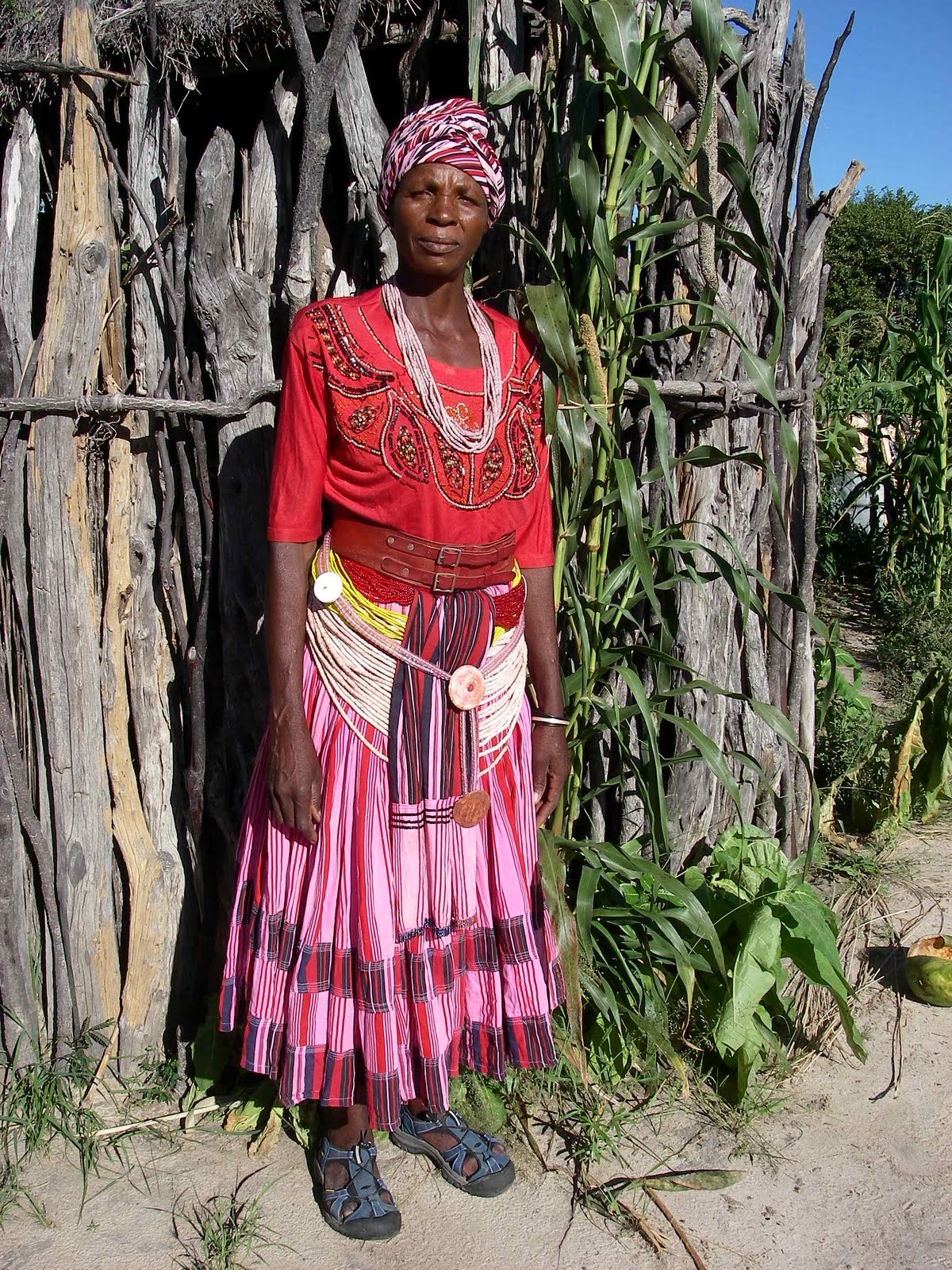
Meme Emilia all gussied up


Emilia, Niita (grade 8), and Tillie (Niita's daughter - more on that later)


Mahangu bending under the wight of its nutrition


Collecting fully grown stalks so the birds have less access


Notice the headwrap, ostrich eggshell necklaces and waistlaces, leather belts, etc.


Pump Plumpkins


The star of the latest horror movie

It's on the attack!


Mwingona with caterpillar


Pails upon buckets


Hexagonal egg balls
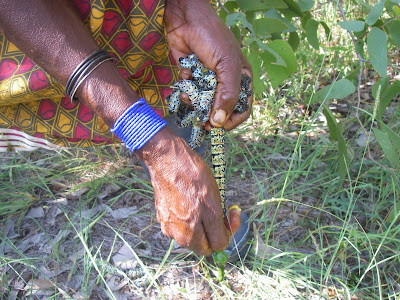

Squeezing the leaf juice


In the Veld


The spiked ones


Caterweelpillar


Stretch bodystrong


Peanut butter and green jelly


Boiling up a snack


The massacre in action


Grubtacular


How appetizing is that?

Meme Emilia and Niita on their way to church