Saturday, June 5, 2010

The first term ended at the end of April and I was very ready for the upcoming month long vacation. Before traveling around Africa, I attended Camp GLOW with five of my learners. GLOW is another Peace Corps sponsored camp much like the Diversity Tour I wrote about last year. Peace Corps Volunteers across Namibia had some of their best and brightest learners apply, and a total of 80 kids, ranging from grade six up to twelve, made the trip to Windhoek for a week full of activities. Each day covered a different topic which included: team building, HIV/AIDS, character building and self esteem, careers and future, gender, and leadership. Some of the highlights include a trip to the Namibian Parliament, a tour of Polytechnic Institute of Namibia, presentations from various professionals (pilot, chiropractor, firefighter, geologist, veterinarian, entrepreneur), and a visit to the cinemas where we watched a cool animated movie about Vikings and dragons. The kids had a great time and I was so impressed by their personalities, ambition, humor, and overall intelligence.


Me with my learners at Camp GLOW (Asser, Lusia, Aina, Rautia, and Leta)


The night of the dance party (Rautia, Asser, Lusia, Leta, and Aina)
Epupa at dawn

After that wonderful but exhausting week, I met up with my buddies Greg and Nate and we set off to Opuwo in Northwest Namibia. This area of the country is home to the Himba people who have a very distinctive style and are seen on almost every guide book cover. Opuwo (which means ‘finished’ or ‘the end’) is also the gateway to the much hyped Epupa waterfall. Our plan was to follow the river, and walk from Epupa until we reached the next waterfall called Ruacana, a distance (we were told) of 100km. We stayed for a night in Opuwo with some friends who had hiked it the previous year, and then left early the next morning to try and make it to Epupa. At the edge of town, the tarred road ends and the gravel road starts and we quickly (in Namibia that means after a few hours) found a ride for N$50 to the next ‘town’ along the way, Okangwati. Then came the real wait. The farther away from Opuwo, which is by no means largely populated, the roads and towns become smaller, quieter, emptier, and more and more remote. So in Okangwati we got dropped off on the dirt road under a nice shady tree and saw less than 10 people the whole rest of the day. For about 7 hours we sat around waiting for a ride and not one car passed. As the sun sank lower and lower, we decided to cook up some lentils for dinner, prepared to set up our tents and settle down, resigned that we would just have to try again tomorrow. But out of nowhere, a truck half full of Himba villagers and corn cobs pulls up and says they’ll take us to Epupa. So we piled in and drove off into the sunset eating our dinners and enjoying sundowner beers while watching the Himba kids herding their livestock home for the night. It was quite a unique day.

We arrived to the small town of Epupa (a collection of tourist lodges and scattered houses) and were graciously allowed to set up our tents in the yard of our driver. In the morning, we caught the sunrise at the edge of the waterfall, which was beautiful, but to be honest, a bit of a letdown after all the hype. So we packed up all our bags and started walking along the dirt road following the river upstream. About midday, our heavy packs were beginning to wear on us, and already some blisters were starting to develop from our infrequently used hiking shoes. It was then that we decided to buy a donkey. We had been joking about the idea before but never gave it serious consideration. We happened to meet a learner traveling home to his village and he directed us to a small riverside collection of shops where he said someone might be willing to sell us a donkey. We bought some ice cold sodas and made some inquiries. The shopkeeper could speak fairly good English but the rest of the villagers were Himbas who speak Oshiherero. So we discussed the matter for a bit but for a while they thought we wanted to hire the donkey along with a guide to take us up to Ruacana. I finally said in Oshiwambo, “Otwa hala okulanda ondongili” (we want to buy a donkey) and the chorus of ‘ohhhhhs’ meant that they finally understood. After that I figured that my Oshiwambo was somehow good enough to communicate with Oshiherero speaking people due to the similarities between the two languages. So we forked over N$500, loaded up two of our bags (the third we took turns carrying), and led our new donkey away by his improvised rope bit. We named him Olaf and he was our companion for the next five days.

Now accompanied by our equine friend, we traveled easier and were able to take in the amazing landscapes as the river wound its way through a mix of terrain as rocky hills gave way to palm trees, and grasslands blended with mopani scrub forests. For five nights and six days we marveled at our remoteness, soaked in the serenity of nature, and wondered how the Himba people still manage to live their traditional lifestyle out in the middle of nowhere. Each morning we would rise with the sun, cook up some oats, pack up our bags, and saddle up Olaf. Then we would walk along the trail stopping at our leisure for photo shoots, snack breaks, the odd conversation with locals, or for anything that struck our fancy. Each night we would find a nice camping spot by the river, unburden Olaf, tie him up to graze, hurriedly take a bath in the river while watching our for crocs and hippos, make a fire, cook up some grub, and hit the hay. There were many memorable moments. One evening Nate had inadvertently taken the wrong fork and we were separated. It was getting dark and luckily a Himba dude comes walking down the path with his cattle so I have a successful conversation with him, me speaking Oshiwambo, and him speaking Oshiherero. Mr. Himba told me that the other white guy had taken the other path up the mountain and then he drew me a map in the sand showing where the paths diverged and then reconnected and told us where we could meet up with our lost comrade. We backtracked for a few minutes and sure enough that’s where we found him, so we thanked the cattle herder and he went on his way.

Another day as we were breaking for a snack, we met four small Himba kids on the path. We took the opportunity for some photos and I showed them some juggling with the smooth river rocks which they immediately tried to imitate. As we drew closer to Ruacana, what to do with Olaf was the question at hand. He had certainly helped us carry our load thus far, and had been a pretty good donkey overall, but he had certainly had his upsides and downsides. None of us knew much about tying cargo on pack animals and several times a day we had to stop and fix the bags because they had shifted or fallen off completely. He got spooked a few times and Greg and I ended up with a few scrapes from being pulled through the brush as he raced away. If we weren’t constantly walking next to and behind him, he had the tendency to gradually slow down to the slowest of walks. By the fifth day, we figured that we had bought the oldest slowest donkey and that he was just plum tuckered out. So we began looking for someone to sell him to, and what do you know, we happen across a couple of teachers who speak perfect English and were driving out to a campsite they are building. They agreed to buy him for N$200 and then asked us for the papers. It turns out that when buying any sort of animal in Namibia, you need the proper documents signed by the owners, the buyers, and the village headman, so it’s possible that we were walking this whole time with an illegitimate and possibly stolen donkey! But they consented to our ignorance and led Olaf off to new pastures.

We weren’t quite sure how much further we had to go because our map wasn’t very accurate or detailed, so we just kept walking. At dusk, we happened upon a bunch of people clearly getting ready for something. So we ask if we could set up camp there, and they tell us that it’s a mobile church and that tonight they are going to be showing a movie! They had a projector and screen all set up and screened an old ‘70s movie about the story of Jesus which was dubbed into Oshiherero. So after bathing in the river (while our new friends threw rocks in the water to scare off crocodiles), we sat with a whole crowd of Himbas way out in the bush, watching this movie under the stars with intermissions for singing and dancing.

The next morning, the trail turned away from the river so we just powered through at our fastest pace yet and after a few particularly tall rocky steep hills, we sighted Ruacana falls in the distance. It was still another few hours but we eventually arrived and reveled in the misty air and soaked our tired bodies in a sheltered pool at the base. The total distance ended up being 150km (about 90 miles) which was significantly more than the original 100km and we felt quite accomplished that we had done it, even with the help of Olaf. We wanted to get to Outapi (another couple hours away by car) and serendipity was on our side once again. The parking lot was deserted but as we were getting ready to walk down to the main road, a family pulls up, looks at the falls for a few minutes, and offers us a ride all the way to town. We celebrated with pizza and drinks and began preparing for our next adventure.
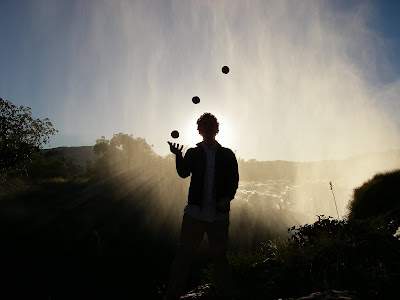
Juggling in the Epupa mist

A river runs through it


Nate and Olaf with me leading the way


Buying Olaf


Juggling with the Himba kids

Coming down from the hills


A Himba lady shows us where we can stay


Maybe my best juggling picture yet

We hitchhiked down to Windhoek and then into Botswana and made our way up to Old Bridge Backpackers in the town of Maun, near the Okavango Delta. After crossing the border into Botswana, we were riding with a nice guy who was driving us to the town of Ghanzi, and all of a sudden the wheel of the car just falls off! We were going about 70 mph and sparks were flying and our insides were in our throats but he was able to hold on and we skidded to a halt. We helped him to fix the tire and then we slowly made it to Ghanzi and he kindly let us sleep at his house on the couches. The next day we caught a legitimate bus to Maun and it was very safe. The delta is amazing. The river just empties straight into the land and the water piles up and makes Namibia look even more like a desert. The water varies from 2 to 6 feet deep and we sat back and floated around in the abundant water in mokoros (traditional Botswanan canoes carved from tree trunks). For three days, through the reeds and between the islands, our two guides steered the mokoros around with long poles while telling us about the trees and wildlife. Unfortunately, we didn’t see many creatures besides spiders, frogs, and birds. But it was a nice relaxing time and much less intense than our last week.

We still weren’t finished with our wanderings. After we hitchhiked back from Botswana we traveled up to the Waterberg Plateau. It’s a very strange earth formation as a massive plateau rises from the completely flat land with rocky cliffs lining the edges. For four days we tramped around on top of the plateau, climbed rocks, made bonfires, and completed the 42km trail. Again, we didn’t see many animals but we did see a roan (maybe a sable), a few klipspringers, a dead eland, and we tracked some squabbling baboons through the bush. The views were incredible and we were completely alone. Not one single other human on that rock besides us three. It was pretty great. I haven’t been able to get the pictures from Greg and Nate so stay tuned to their blogs (Greg’s: http://greginnamibia.blogspot.com/ and Nate’s: http://natebloss.blogspot.com/)

A critter from Waterberg

Alright that’s it for now. More photos to come. World Cup is upon us and a trip to Cape Town for the quarterfinals is in the works! Hope it pans out!!

Peace, Parker

Saturday, May 29, 2010

Creepy Crawlers

There are almost two months to recap so here goes...

After the snake incident I was very wary for a while but thankfully there have been no more reptilian encounters. The bats in the toilet, however, are another issue. Every time I go to sit down on the pot, the squeaking and fluttering of wings sends shivers of apprehension coursing through my body because I really don’t want bats flying up my bum. A fellow volunteer friend described his experience with a bat that did just that, and it surely would be memorable but not necessarily a memory I would want to have.

The interactions with wild creepy crawlies do not stop there. Skinks and geckoes hide in the cracks, spiders scurry up the walls, and every so often there will be a giant ongongololo (millipede) undulating its way around the homestead. And during the end of the rainy season, the Mopani trees are rife with omagungu (caterpillars) chomping away at the distinctively angel-wing-shaped leaves. The appearance of these finger-long spiny creatures is a huge deal for the Owambo people. For the whole of March and April, Meme Emilia and the kids were out in the bush veld every day harvesting the delectable ‘worms’ as they are called. The caterpillars don’t have eyes and just blindly munch their way through the leaves, leaving swathes of bare trees in their wake. But it’s a good thing because the caterpillars grow incredibly fast and that means more good eats for the people.

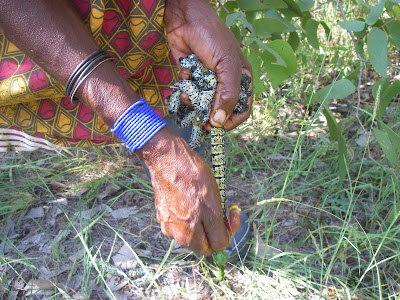
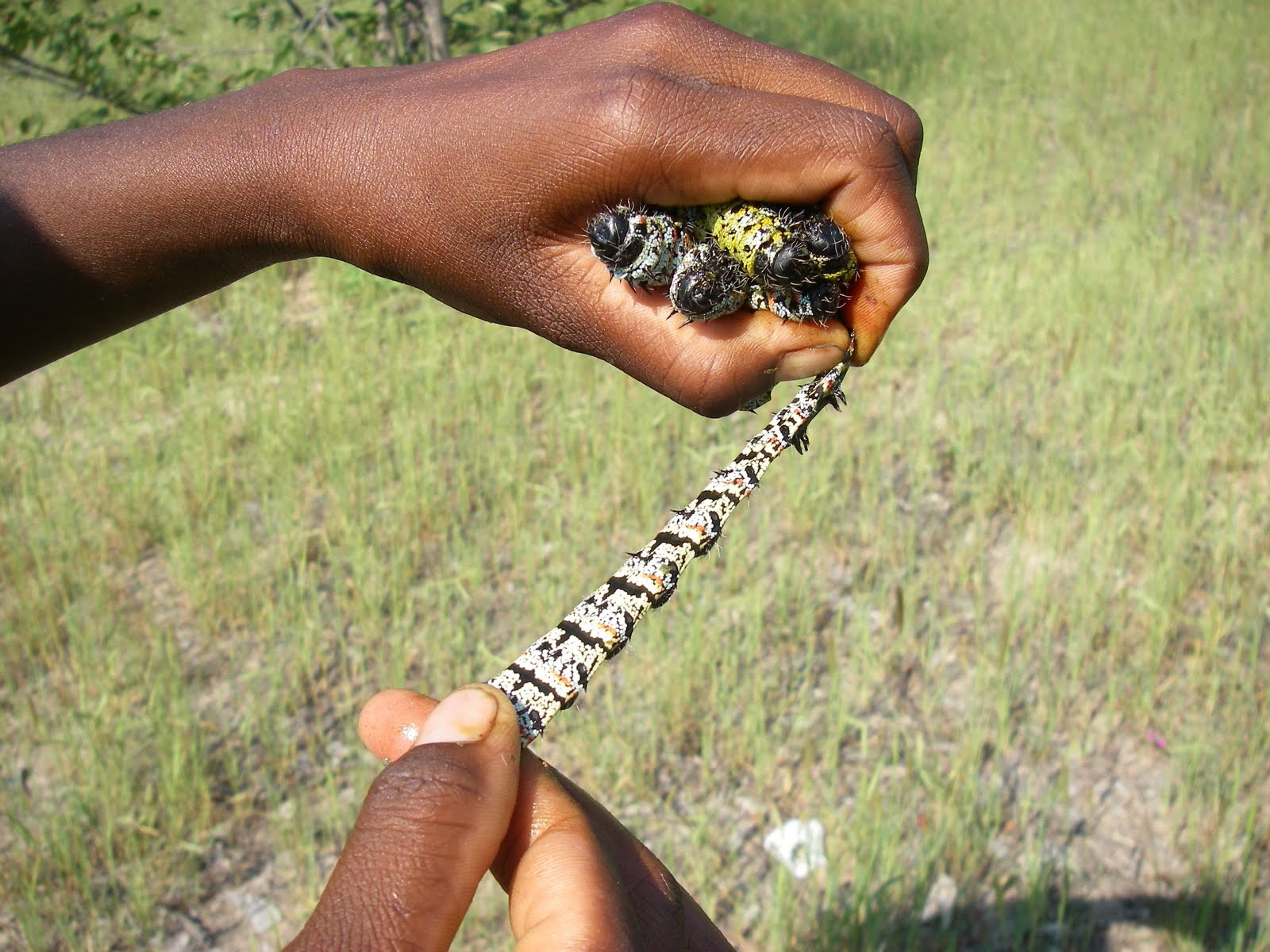
It’s extremely easy to find them in the trees and all you have to do is just pluck them off while avoiding the surprisingly sharp spikes that adorn their redwhitegreenblack backs. The next step is to squeeze out the innards along with the partially digested leaf juice, so you pinch the head and run your fingers down the body which expels some lovely green jelly. In a single afternoon, pails upon buckets are gathered and then the cooking can begin. Sometimes they are just boiled in a pot over the fire, but the preferred method is to bury them in a pit in a sandy treeless stretch and roast them by making a huge bonfire on top. They make for quite a tasty snack and are sold, bought, given, transported, and of course, eaten for the rest of the year. After the caterpillars are cooked, they keep very well, but I much prefer the fresh ones, although the day I decided to eat 30+ of those babies was a sad day for my digestive and excretory systems.
Another item for the Namibian menu is right out of The Lion King from the scene where Pumba is showing Simba what non-meat things are to be had: GRUBS! I really don’t have any idea what an enkagali is, but it suffices to call it a grub of some sort. One evening I went with Mwingona and Egumbo to put the goats in the corral and then they showed me what was for dinner that night. They proceeded to take some hoes and dig around the cow pie-caked dirt and unearthed a bunch of these pale white goobers that were so fat as if they were about to burst. Which is exactly what they then did, helped along by two strong hands and a sharp stick. The jelly this time wasn’t a pleasant lively green as in the caterpillars but instead it was an inky deathly black. When it was time to return to the homestead to cook up dinner, the puncturing block was slathered with the aftermath of a massacre. Fried up with some salt and tomatoes, they were actually quite tasty if you could forget about their origins.

I just returned from a month long vacation but my internet time is up now so I will have to write about it next time. Brief overview: bought a donkey, walked 90 miles, showed Himba children how to juggle, sold the donkey, swam in the river, hitchhiked to Botswana, floated in traditional mokoros (canoes) for three days in the Okavango delta, hitchhiked back to Namibia, real hiked up Waterberg plateau, deathdefyingly climbed some boulders to capture some awesome juggling pictures, tracked baboons, and made it safely back to village in time for school.
More to come… stay tuned


Meme Emilia all gussied up


Emilia, Niita (grade 8), and Tillie (Niita's daughter - more on that later)


Mahangu bending under the wight of its nutrition


Collecting fully grown stalks so the birds have less access


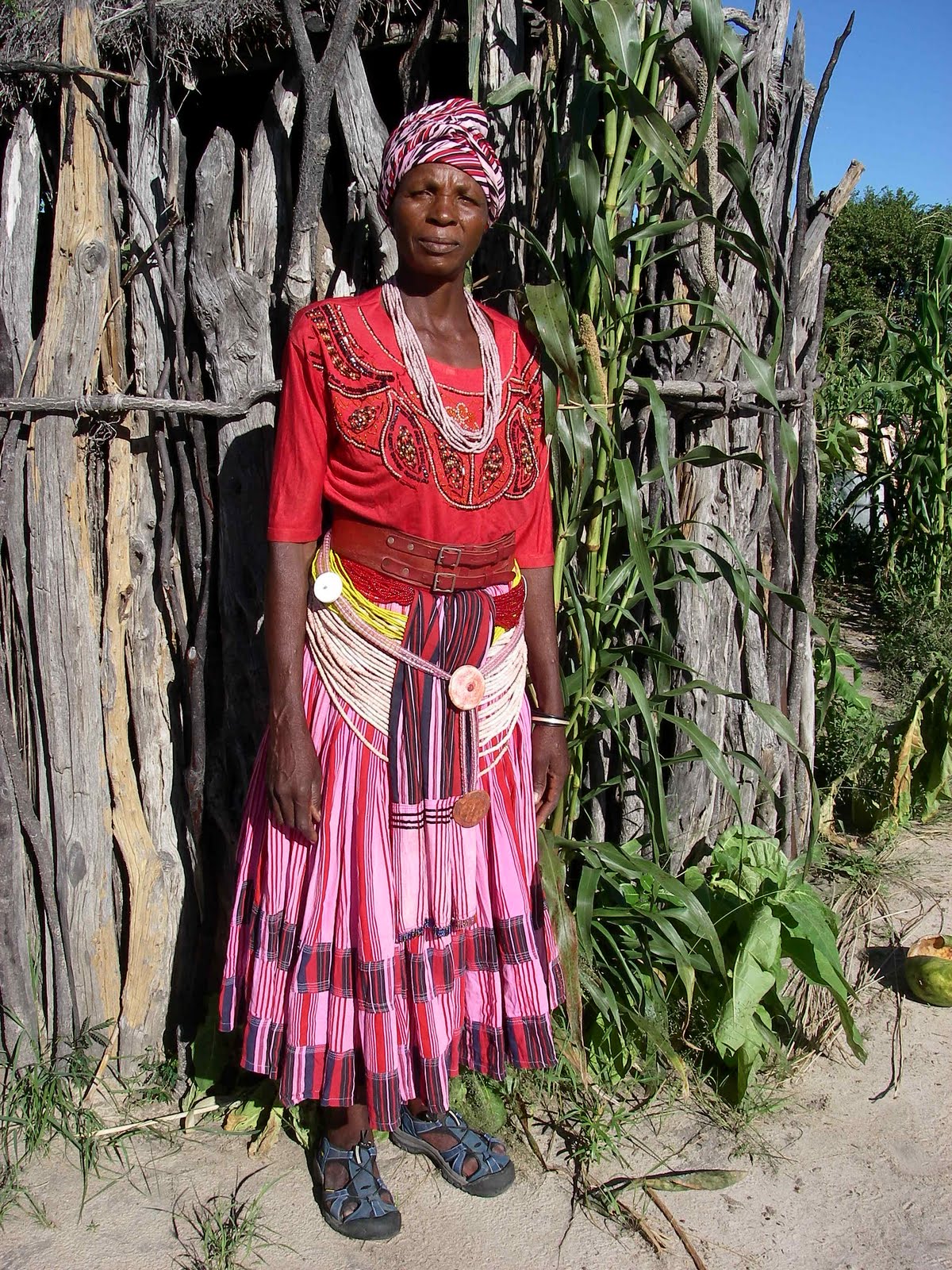
Notice the headwrap, ostrich eggshell necklaces and waistlaces, leather belts, etc.


Pump Plumpkins


The star of the latest horror movie

It's on the attack!


Mwingona with caterpillar


Pails upon buckets


Hexagonal egg balls


Squeezing the leaf juice


In the Veld


The spiked ones


Caterweelpillar


Stretch bodystrong


Peanut butter and green jelly


Boiling up a snack


The massacre in action


Grubtacular


How appetizing is that?

Meme Emilia and Niita on their way to church

Sunday, April 4, 2010

Elyadhila - The Bird Eater

I had a bit of a run in last week... I was readying myself for an afternoon game of soccer and walked into the toilet building only to hear a strange raspy hissing noise. Looking down, my vision immediately recognized the slithering coils of a huge snake lurking along the base of the wall and set in motion my rapid retreat. I moved so fast as I jumped back out of the building that I might have set a new land speed record! Putting some distance between myself and the snake I regained my composure. The other teachers had all left so I called over the learners since they were more likely than I to have had snake encounters. And as the crowd gathered, two of the more confident (or foolhardy?) boys grabbed an arsenal of sticks and stones intending to break some snake bones. Then ensued a battle to the death, and I was worried someone would be bitten and I would be pinned with the responsibility. But I didn't know what else to do and the kids were intent on destroying the danger. So I urged caution and had the crowd maintain a semi-safe distance as the war was waged. In the end, a few well placed strikes put some dents in the scaly beast, and though still writhing, the danger was averted. After the excitement, we played our soccer game, and I came back a few hours later to snap some pics. The next days, I showed my colleagues and they were impressed with the size and determined it to be some sort of highly venomous cobra. One bite would probably be lethal! So I thank my adrenaline and reflexes for my safe escape.


Friday, February 26, 2010

Phruitphul

A few more pics of the plowing process and from an afternoon in the fields...
The recently-plowed fields with our homestead in the background


The donkeys plod along


Sad sackers...

Meme Emilia with cow horn and ongongo


Demonstrating the method of singular consumption


The bountiful tree and its fruitspring


That bucket weighs about 50 pounds


My artistic close up on the post-liquidized fruits


Kola-ing in action


The workstation that produces the sweetly-sourly alcoholic omagongo

Saturday, February 20, 2010

The fruits of their labor

Cultivation time has come to Namibia. The rainy season is here but compared to last year it is much more mild. At least so far... People in villages all across Owamboland are busy tending the fields and working like mad in all aspects of farming. It's a never-ending process. One of the first steps is to clear the leftovers from last years crops. Old corn husk, sorghum stalks, and other rubbishes are rounded up, dug out of the ground and burned. Burning has something to do with nitrates are other minerals (agriculture is not my gig) as well as clearing the slate to start afresh with clean fields. With the first rains, they gauge whether it's time to plant. Sometimes the rains can be deceiving and if they decide to go for it but then the sweet nourishing moisture disappears for weeks, they are sadly out of luck. So when they take the plunge, they go whole hog, or should I say whole donkey. If there is no money to hire a tractor, plowing is done the old fashioned way: with donkey and rusty old metal plow.


Shitaleni and Egumbo plus donkey workers

When the fields are furrowed and ready to go, planting is the next step. I've helped out with this a few times this year but I really can't take any credit because planting a few rows of corn is equivalent to about 1% of the total work that goes into a successful harvest. With corn, they plant two two two in hoed holes and then cover each hole with the previously excavated dirt. With mahangu (millet), they scatter a small handful every few feet or so. With bean, it's one one one. With iishenda and omatanga (two kinds of gourds), it's a few seeds of each in holes dug close to the fence which acts as a trellis for the skyward-bound creepers. All the while, the capering chickens, guileful goats, boisterous birds, and marauding mice are an ever-present threat. The chickens are difficult to control but once the seeds have been set in the ground a few days, those clucking featherbags are no longer a problem. The fences are kept secure so those nimble goat fiends can't find a fortuitous foothold. Pots and pans are banged, scarecrows are erected, and voices call out with bird-curdling shrieks to keep the flying chattering beaked ones at bay. Mice are tricky buggers and the most people can do is give the cats a lot of encouragement. Traps are mildly effective but sometimes non-targeted prey becomes the victim. That's how I found myself feasting on rabbit last year. My view towards most all creatures is to leave and let live, but these people who depend on subsistence farming do not have the luxury to make that sort of humane decision. They need to eat, they need food, and they will not sacrifice their crops so that nonhuman animals can eat instead. So the battle wages on...

Once the seeds have been sown, lots of attention is directed towards the clouds. Too little rain and the crops will wither and die under the relentless rays. Too much rain and the crops could drown, which is what happened last year to all the omatanga. But somewhere in the middle is just right. It's kind of a Goldilocks situation, but more real, and with less bears. The rains this year have been about perfect. Once every few days there are some light showers during the night and about once every ten days is a big thunder and lightning storm that gives the earth a good soaking. Let's hope it continues in this manner. As the water energizes the plants and the lush greenery begins to cover the fields, the unwanted plant cousins invade. Some common intruders are onjohwa (a thorny spiny monstrous weed that actively seeks out any bare feet),etse lyakuku (the grandmother's head - a colloquial name for a rather innocuous weed),omwidhi (common grass), and onyanganyanga (an onion like bulb that apparently is poisonous if eaten. Hoes are the trusty weapons used in this floral combat zone by warriors of all ages, from grandmothers bent with age to toddlers who can hardly lift their implements of plant defense. It is a daily chore and Mwingona, Meme, and Egumbo (along with any generous neighbors) can be found in the fields twice a day: from before dawn until time to go to school, and again from a little before dusk until time for supper.


Egumbo, Niita, and Mwingona hoeing the floral intruders


On top of all the work that goes into growing maize, mahangu, sorghum, beans, gourds, and ground nuts, there is also the fruits of the omuye and omugongo trees to be had. The omuyetrees yield thousands of yellowish pinkie toe-sized berries called oombe that are a definite village favorite. They are quite sweet but unfortunately have a pit inside so there is not much actual fruit to eat. But the taste is exquisite. I choose to anagrammatically spit the pits but most people just swallow everything. In my oshiwambo dictionary, oombe is defined as a bird plum so maybe it's on the internet somewhere. From the omugongo trees come the wonderful and bountiful oongongo fruits commonly known as marula. They are golf ball-sized and also have a large pit inside. The soft juiciness around the pit though is a prized commodity in the village. They can be eaten one by one and the best way to do so is to soften up the insides before biting a small hole in the semi-thick skin and sucking out the sweet tangy juice. I like this method but after five or so, your tongue feels as if you have eaten a whole bag of super sour candy. The more common way though is for a family to spend an entire afternoon sitting out in the field under one of their omugongo trees gathering the fallen treasure into piles and kola-ing. Kola translates as 'liquidize' which is basically what happens. An old cow horn is used to pierce the yellowed orbs and the squirting juice is collected in buckets which when consumed in large quantities can be quite intoxicating. A watered down version is much more palatable and is called oshiwa. The thousands of pits from the used oongongo are poured into piles around the homestead and saved for many months. By August the remnants of the pulp is completely gone and all that is left is a marble-sized nut. They are cracked open day after day in endless tedium but the result is large bowls filled with white nuts (omashuku) which can be eaten plain or pounded until a nice nut oil forms which is then poured on various side dishes. It is so much work. You have no idea. I could go on and on about how much work people do in Namibia but it is late. I have had several conversations about this topic with meme and one such encounter could go like this in which I say, "Oh, meme, moNamibia okuna iilongaoyindji! KoAmerika ongele aantu oya hala iikulya, otaya yi
kositola okulanda" = "oh, my mother, in Namibia there is so much work! In America if people want food, they just go to the store to buy." And she says "oh aiyaiyai eeno, iilonga oyindji.
Onda vulwa shinene na otandikulupa." = "(sounds of distress or annoyance) of course, there is so much work. I get very tired and I am getting old." But she says it with a smile and her constantly positive and joking attitude. She is 54 and has had 5 kids and I will be very sad to say goodbye. She doesn't speak any English but is probably the closest Namibian friend I have. I started talking about cultivating but got sidetracked about my host family, some really great people who I should write more about. Next time. Arrividerci!


Niita, Tillye, Mwingona and Meme liquidizing the marula fruits


Meme ota kola

Messy Onesi

Pronounced as if you were consoling the famous Scottish loch monster - Oh nessie

Two weeks ago marked the start of after school training for athletics, which we would refer to as track and field. When classes finished for the day, almost the whole school could be found out on the sports field whether they were running or not, enticed by the novelty of something different than their regular walks home through the bush. Mr. Musilika, the teacher directing the show, would vainly try and round up the runners in each age bracket for the various events which include the 100m, 200m, 400m, 800m, 1500, and 5000m. The young kids were completely uninhibited and eager to go, but as the age groups progressed, reluctancy to step up to the starting line began to seep into the collective mindset of the potential athletes as the fear of failure and the merciless teasing of their peers wrought havoc on their confidence. More than that though, was the complete and utter disorganization that seems to plague events of all kinds that occur in Namibia. Musilika would manage to corral a few of the 400m girls, but then while trying to find the other kids he knew to be strong runners, the original group would disperse and the gathering process would have to start again. Despite these setbacks, some training did get accomplished albeit with no warm up jogs, no equipment, and no formal coaching on running technique or strategy. The next day I brought my running shoes and managed to instill more enthusiasm in the masses by going on a longer run with a large group who were suddenly raring to go. It almost killed me though. I hadn't played soccer, juggled, or done anything active for almost two months, so I was later ruing the decision to go on a thirty minute run in the 100 degree heat without satisfactory hydration. I managed to run the whole way but probably could have been diagnosed with heat stroke and lactic acid overdose. Let me tell you, those kids smoked me! They are so amazingly fit that when they arrived back at school, well before me I might add, they continued doing a few more laps around the field! The fact that they are so tough must be that they grew up living, working, and playing in this constant heat, not to mention that their stringy muscular bodies carry them upwards of 10km every day as they walk to and from school. And most probably eat just one meal a day at dinner. Very Impressive. I survived the first day and now that I know how blazingly merciless the African sun can be at two in the afternoon, I have run a few more days since then with a marked improvement in my endurance and stamina. Less than one week of training was all we got before Musilka, who can be quite a spacey character, came to me on Friday afternoon at 1:30 (20 minutes before school ends and everyone goes home) with the information that Saturday is the zonal competition for schools in our region.

Me - This Saturday? (incredulous at the timing)
Musilika - Yes it must be (obviously, what's the big deal...?)
Me - You mean tomorrow? (still incredulous)
Musilika - Yes they changed the date and I just remembered today (his spaciness on display)
Me - But it's too late now, how will we get there? (the American way, bent on full preparation and precise planning)
Musilika - Ahh maybe I can ask Amputu (a fellow teacher with a pickup, but alas he is not available tomorrow)
Me - Maybe Meme Maha? (another teacher with a truck, but again, no luck)
Musilika - Well, I know some people in Tsandi who I can try to ask tomorrow in the morning (the string of hopeful ideas continues)
Me - Ok, so which learners can we take? Will we meet you there? (trying to formulate an orderly plan)
Musilika - Yeah just start walking to Tsandi in the morning and I think you will meet the learners on the way (the Namibian version of a plan)
Me - Ok see you tommorrow then (after a year plus in Africa, I have learned to go with the flow)

This is a very typical example of how things works in Namibia: last minute information, countless unknowns, and a lot that is left up to chance, yet it usually seems to work out in the end. We quickly told the learners before school ended, and the ones that wanted to go said they would walk the 8km to Tsandi in the morning and that some would be meeting at the school at 6am. I suggested 6:30, counting on the requisite lateness due to African Standard Time, and planned to meet them at 7. So the next morning I arrive at the school at 7 and of course no one is there yet. A few show up at 7:15 and we start the two hour walk to town. Along the way, more and more learners join our entourage and by the time we reached Tsandi, we had amassed 14 kids, which seemed like quite a good turn out considering the situation. The competition was to be held in Onesi which is a small 'town' about 30km from Tsandi. The idea behind the zonal competition was to invite the relatively nearby schools to a central location and send the qualifying runners on to Oshakati to the regional meet for all athletes from all four regions of Owamboland (Oshana, Oshikoto, Ohangwena, Omusati). Elamba is just one of many schools that were invited to the Onesi meet, which was one of several zonal meets for all schools in the Omusati region.

Musilika managed to convince one guy to drive all of us to and from Onesi for a fee of N$260, so we two teachers squeezed into the cab and the learners piled into the back of the pickup truck and perched themselves around the edges in a way that would make any American mother sick with worry. But that is how things are done here and, rest assured, we all arrived safely in Onesi around 10, late for only the first race, which fortunately, none of our kids were running. The 'track' at the school where these qualifying races were being run turned out to be no more than an overgrown field rife with dead plants, animal dung, bottles and other rubbish. What an ideal and pristine location! We quickly learned that several of the other schools weren't as resourceful as we were, as only half of those invited were able to make it. Apparently we were not the only ones informed at the last second. I assume you all have been to, or participated in, a junior high or high school track meet and maybe you are picturing that scene, only in Africa. That image is definitely as far as could be from a Namibian track meet at a rural village school.

No lanes and curved corners for the track - instead a few spectators stood at what seemed to be to the right distance and physically created the corner for runners to go around. Several runners got confused and were disqualified for going on the wrong side, several collisions and falls resulted when runners tried to turn the sharp corners too fast, and a few times the corner-marking spectators fled in fear when the older stronger faster boys came bearing down on them at full speed. I just had to laugh at how ridiculous those moments were.
No measurements were taken - the 'organizers' just estimated the distance of 100m by taking 100 long strides 4 times to form a large squarish space. Not exactly the Olympic-regulation-sized ovals we are used to. I have no idea how they measured the 5000m course.

No equipment whatsoever...
No starting gun - one guy was the designated starter and yelled "Ready?! On your marks! Go!" without any real consistency or rhythm, and oftentimes he didn't even check to make sure that all the runners were ready. I can't tell you how many false starts there were.
No starting line - they just cut a wavy line into the scrubby grass with hoes.
No starting blocks - instead the runners knelt behind that nonlinear line and tried to get a grip on the dusty ground.
No finish tape - they tied a bunch of skinny palm tree leave together to form a rope of sorts, but more often than not they forgot to hold it up for the finishing runners.
No megaphone to make announcements - the organizers just shouted results across the field and a few kids missed their races because they didn't know when they were starting.
No stopwatch - the top two runners from each heat, regardless of their times, moved on to a final heat which determined the two kids from each category that qualified to go to Oshakati.
No changing rooms or bathrooms - both activities took place behind distant bushes.
No running shoes or uniforms - running barefoot is the norm and they just wore whatever clothing they had that approximated loose lightweight apparel. Some kids had nothing, or forgot it at home, and chose to run in sweaters, long skirts, and even jeans!

But none of that mattered to the kids. They had a blast and so did I. I bought some bread and juice concentrate for our midday snack and we commandeered a bucket of unknown cleanliness from a neighboring school and mixed in water from the nearby church. Cups were created from plastic bottles cut in half with a rusty knife and we reveled in sticky orangey sweet happiness. I forgot my umbrella but braved the murderous sun to provide moral support and encouragement for my fledgling athletes. They were understandably exhausted after their races and I helped them deliriously navigate their way back to the shade tree. It was also a chance for us to see another community, as most of my learners had never been to Onesi even though it is only 30km away. We were able to walk through the 'downtown' which consists of a finitely countable set of shops and bars, and our conversations about what we saw were more free and open than classroom math lessons. Johannes Niilenge says to the others, "with sir you must talk English and also you must laugh in English!" When I asked if they get blisters he says, "oh! sir, when the ground is too hot, my feet are so hot!" Walking back from the shop, Sakaria Sheehama says, "sir, your English is ok, we understand you, but oh!, when your mother was here, no we can't understand." At the end of the day, we left in good spirits and even had six kids qualify for the larger regional meet. I will make sure to bring my camera next time as unfortunately I have no documentation to give a better sense to my wordy descriptions. The meet in Oshakati is happening next weekend, and although I'm predicting better facilities and hoping for a bit more organization, I'm sure it will be another memorable experience.