Monday, June 29, 2009

Two Weeks with Paka

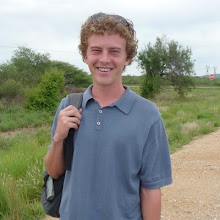
What an experience to be able to visit Parker (I had not seen him since he left back in November) and see not only his home and teaching environment but share traveling to several areas of Namibia that neither of us had ever seen.

I arrived in the capital city Windhoek and met Parker at the guest house we had reserved. After one night and a good meal with two of his fellow Peace Corps volunteers, we headed to the west coast to visit Swakupmond and Walvis Bay where we spent 2 nights. We had a fantastic kayak tour of a seal colony where a couple of hundred thousand seals reside. It was great fun paddling and watching how curious of us they were. Many would swim right next to us and nibble at our paddles and then splash us and swim away.


We headed up to climb the vast great sand dunes and then northeast to Damaraland to hike to see the White Lady Paintings. These ancient paintings and carvings are 5000-6000 years old. Then it was on to Etosha National Park to tour the water holes for 2 days viewing animals. We were able to see antelope, elephant, giraffe, zebra, jackal, hyena and lion. Absolutely amazing to see these animals in their natural habitat from the safety of our truck and have so many walk right by us. Off to Ovamboland where Parker lives in northern Namibian near the Angola border, to stay with him in his homestead and visit the school for 4 days before having to leave for home.


I have to be the proud father now and brag about my son and how absolutely proud of him I am for what he is doing and the conditions he works with.

Parker is five miles from the closest electricity and in the homestead where he lives there is one water faucet. It’s bucket bathing each day and when the sun sets it is definitely lights out- other than the brilliant stars, it is pitch black.

The school is a 15 minute walk from home and is also without power. The learners all respect Parker and seem to enjoy his teaching, humor and soccer skills- although they are so shy and reserved. The school has minimal supplies and resources. With no electricity there are no computers, no copy machines, no music and no video opportunities. Lesson plans are written on the chalk board and copied on paper or sometimes practiced in work books. That said, the kids seem happy and watching them interact together at break time or recess, its like watching kids in any school- laughing and playing with patched jump ropes, chasing and the little boys wrestling.

I was able to bring with me several soccer balls, basketballs, jump ropes and some school supplies. The principal assembled the students and told them of the gifts from several friends back home. They were so excited to have new things. School was basically called off the rest of the day and they all played with the jump ropes and balls. They are able to check them out from the principals office for recess and also after school for soccer practice.

The school has a soccer team which Parker coaches after school, and through a donation from Lake Washington Youth Soccer I was able to bring about 2 dozen jerseys for the team. They were so excited and so ready to use them in the upcoming games as they have never had official jerseys.


It’s amazing to listen to how fluent Parker is in the native language of Oshiwambo. Life in the homestead and surroundings is quite simple and the family he lives with along with the neighbors seem to really enjoy having Parker in their lives.

You’re doing a good thing Parker and I am so proud of you. I miss you and am so thankful that I had the opportunity to visit and spend time with you.


Love Dad

Tuesday, June 16, 2009

Multitudinous Meanderings

A bonafide fully equipped computer sits in front of me hooked up to a legitimate internet source so hopefully I can whip up a comprehensive update about the last month before I leave for my next adventure. Term one ended in late April and my learners did well by Namibian education standards. Maybe I was too lenient with my marking or maybe I made the final exams too easy, because there was quite a large discrepancy when I compared the math results for my learners with their results in other subjects. If I erred, at least my error boosted their confidence. My last day of school found me scrambling to finish up grading and completing various forms, and then I waved goodbye to the homeward bound learners as I sped by in the back of a pickup truck on the way out of the village. A series of taxis brought me to a fellow volunteer’s homestead where I stayed the night before continuing on to Windhoek the next morning. Did I mention that in addition to my full backpacking pack, I was lugging around an extra bag of books and a huge 20 pound squash? It’s the Owambo style to give gifts for the dinner table and already in my short time on the homestead, I’ve received countless chickens, squashes, pumpkins, ears of corn etc. from village families. So on the day I was leaving to go south, Meme brings me this massive gourd and tells me that it’s a gift for the Peace Corps staff. I didn’t really fancy the prospect of traveling for hours toting this extra weight around so I tried to ‘forget’ it at home. But I had forgotten something else at home (for real this time) so I had to go back, and then there was no escape from being squashed by the squash. Luckily the taxis didn’t charge me extra for my big bags and child-size vegetable. My friend and I woke up early the next morning and tried our luck at hitchhiking the rest of the way to Windhoek. Our first attempt was soured by a crafty truck driver who, after a miscommunication, ended up charging us for the slow ride to Tsumeb. But then we hit the jackpot when two German-Namibians picked us up in a nice SUV, treated us to lunch, and dropped us off at the front door of the hotel! The two of us came down early because we successfully applied for the Volunteer Support Network and had our inaugural meeting to attend. VSN is a service for volunteers to use when they need a break from the ridiculousness that life in Namibia can sometimes be. We were trained in ‘active listening’ with the idea of providing a venting source for volunteers with frustrations, concerns, questions, or quandaries. The other part of being a VSN member is that we get to help welcome the new volunteers to the country and lead sessions during their training. After a couple days, the rest of the volunteers arrived in Windhoek for ‘reconnect’ after our initial three months at site. What followed was two weeks of refresher courses including Peace Corps policies, information about funding sources, secondary projects, more language training, and tips for effective teaching. It was a lot to take in all at once, so although it was great to see friends after such a long absence, I was more than ready to hit the road especially since the destination was the much-hyped Fish River Canyon.


Just the word ‘river’ has such a strong attraction after three months in sweltering normality, and the rave reviews from previous expeditions sent the anticipation meters to record levels. The five days we spent trekking (double k words are pretty rare) in the epic Namibian wilderness didn’t disappoint. It was as if the nature dial was turned to maximum, and we took full advantage. Beautiful panoramas, secretive wildlife, brisk skinny dips in the river, exotic juggling, and plenty of try-not-to-get-your-feet-wet river-crossing problems, all combined to send to the overall experience to the top of the camping charts. I managed to take lots of scenic juggling pictures but they don’t quite do justice to the natural splendor so I will direct you here to view and be envious: http://greginnamibia.blogspot.com/


There was a slight interruption in this post. I just now returned from a weekend getaway in Tsintsabis and Tsumeb and before the tales keep on piling up, I must write down some more stories before the memories fade. A reversal of the timeline is now in effect so I will start with this last weekend and work backwards to where I left off. One kilometer outside the small town of Tsintsabis is the Treesleepers campsite (http://www.treesleeper.org/) named for the traditional tactic of the San people who slept in certain trees to avoid curious predators. Some friends and I spent a couple days in the bush where we went on a nature walk to learn the basics of traditional hunting and gathering which included how to catch guinea fowl with a rope snare, how to identify poisonous plants and use them to lethally enhance arrows, how to read and identify animal tracks, how to start a fire without matches or a lighter, and how to utilize trees for meat storage and defense against rogue lions. That same night we were privileged to see some traditional dancing and singing around the fire with the accompanying traditional instruments and dress. Previously, my cursory knowledge of the native people of the Kalahari Desert was gleamed from the classic movie, The Gods Must Be Crazy. The portrayal is true to some extent but much information is left out. There are many parallels between the San people and the Native American: various tribes with different languages, intimate knowledge of flora and fauna, expert survival skills, countless deaths at the hands of foreign invaders, and the loss of traditional practices as modernization spread. The name 'Bushman' is the derogatory equivalent of 'Indians'. San is the more commonly accepted term nowadays but even that isn't totally correct, as the San are only one tribe of the many. It was a fascinating weekend but as usual with those types experiences, we were left with mixed feelings of awe and sadness. Then, when it was time to leave, serendipity once again pulled through and we instantly found a free ride for all eight of us back to Tsumeb where we went on a spree that demonstrated how different modern times are from the eons of traditional life. We treated our taste buds to avocado-laden burgers and chocolate milkshakes for lunch and real Italian pizza for dinner. All of that culinary extravagance was followed by a night at a hostel with satellite TV and hot showers. The quintessential necessities for a perfect break from porridge, sand, and isolation.

Now it is time to return to Elamba Combined School in Okatha Kombago village. Last Friday, our school soccer team played it's inaugural game in the newly donated uniforms courtesy of the Crossfire select team from Washington. The learners loved showing off the new kits and were able to celebrate with a 3-0 win over some local village boys. Huge thanks to the generous donors and to my dad for transporting all the gear to rural Africa. After the jaunt in the canyon, I met father in Windhoek and we began our great two-week trip all around Namibia which culminated in a visit to the homestead, village, and school. In a brief recap, we kayaked with seals on the coast, climbed huge sand dunes, avoided bright green chameleons on the road, tracked hyenas and giraffes in Etosha National Park, navigated the endless shebeen-infested towns, had translated conversations (thanks to my language prowess) with my host family and other village elders, and spent a few days with the incredibly shy learners. I won't go into great detail as I'm hoping that my dad can add his input about our trip and give a different perspective. He also has plenty of pictures to share which will hopefully make up for the lack in this post. I would like to comment though on the two huge duffel bags he carted all the way here and how appreciated they are. I am completely loaded with all sorts of goodies including Time and Newsweek magazines, candy bars, running shoes, and a hammock! I'm reveling with all the abnormal luxury. Maybe a little too fast though as almost all the candy has been consumed... Overall the visit was wonderful and it was hard to say goodbye. But I am back into village mode now and ready for school again tomorrow. Hope all is well in your various locales and that you can find enough time to zip me a quick email: pakalewis@gmail.com

Iyaalo! Tangi Tangi! Kaleni po nawa

Paka

Friday, April 10, 2009

Aalongwa = The people who are being taught

Finally here are some pictures of those endearing learners that I keep mentioning.  Each grade has its own classroom which they stay in all day while the teachers rotate every class period, the end of which is signaled by a cow bell rung by a grade 10 learner.  I stay in the homestead with the Grade 7 girl with the neon green sweater.


Grade 9


Grade 7 


Grade 8 + my Caprivian colleague (can you spot him?)

Ruacana is Falling!


The intrepid juggler braves the onslaught that is Ruacana Falls


Zombie Juggler!!  Look out!!

Friday, March 27, 2009

Omeya oga pwina (the water dried up)

After a tumultuous few weeks where plans were never certain and floods were discussed at length, I'm now happily back in a very dry village. I spent a week with my friend Greg (http://greginnamibia.blogspot.com) during the first evacuation and was able to experience life with another Owambo family. Although their lifestyle is, in many ways, very similar to my host family, it is interesting to note some of the major differences. We still ate Oshithima every night, but they use maize flour instead of mahangu flour. We speak the same language, but their dialect of Oshiwambo changes the pronunciation of J to G and AY to OH. Their homestead is still a labyrinthian construction of huts and fences, but there are several more cement buildings as well as, wonder of all wonders, electricity! Due to this foreign amenity, I was a little spoiled for that week, but it didn't even compare to the luxury of Evacuation Round Two! While I thoroughly enjoyed my mini-vacation at Greg's, I was eager to get back to my host family and learners. It's not that my teaching mentality was fading or that my soccer skills were rusting, because I actually taught some math classes for a busy teacher and played etanga after school with the learners. (etanga = ay tong uh = ball) But I was feeling the pangs of homestead-sickness and a little out of my established education element. It was difficult to say goodbye to the satellite TV soccer matches, the warm water bucket baths, the wonderfully cute kids who live with Greg, and my new class of grade eight learners, but I was able to return to my site and start back at school the following Monday.

My joyous return, however, was shortlived. Even though the heavy rains had ceased and there was much less goop to walk through, the higher-ups decided that all of the volunteers who live beyond a certain bridge should be evacuated to the 'safer' side. And so begins our adventures at the Seven Valleys (www.namibweb.com/sevenvalleys.htm). The dreaded Angolan floods were again the source of all the trouble. The fear being that the aforementioned bridge would wash out and we would be stranded. So four of us were whisked away to the safety of the posh corps hotel, complete with air conditioning, hot showers, and buffet breakfasts! We could hardly complain, but as the rainless days piled up with no sign of the bridge collapsing, we started to get antsy. During the long obligation-free week, I spent my time playing computer games, watching movies, reading books, solving crossword puzzles, juggling, and thinking of the following witty puns appropriate to the situation:

(Note: omeya = oh-may-uh = water) I'm a bit beFLOODled by the extent of this unFATHOMably long evacuation. It's OMEYAzing that we haven't been sent yet, because the bridge doesn't even look that thWETened. WATER they so worried about? Ok that's enough horRAINdous wordplay for now.

Upon returning to the village, I was quick to get back into the Owambo swing of things. By then, the rainwater had almost completely dried up and reconstruction had begun on the damaged huts and fences. Unfortunately, nothing could be done to save the watermelons, so their juicy corpulent futures won't be realized this year. Other than the countless deaths of these immature fruitballs, there was no major damage to the homestead or the school. The learners did well, by Namibian standards, on their first math tests which included some Namibian-esque story problems. (That means the topics ranged from goats and frogs to Oshithima and omeya) I gave the learners that scored the best ten grades a piece of candy and they loved it. This week at school, the learners are busy writing penpal letters and are really excited to hear back from the American students.

Here are some quality excerpts: From a grade nine learner: 'I am a famous boy known not just that i am intelligent but also because i am always screaming a hell out of my voice and jumping up and down once there is no teacher around the corner or inside the class. I'm hyperactive.' From a grade ten learner: 'My name is andreas. I am sixteen year boy. My hobbies are playing soccer, dancing, signing, and reading book. I hate soft misic. I am a namibian.' From a grade eight learner: 'My favourite food is catapilla and makaloni and frog meats. Don't be scared by our culture foods.' So needless to say, this should be an interesting cross-cultural exchange!

Other than the evacuation, life in Northern Namibia is pretty simple. I wake with the dawn, walk to school, try and be a fun teacher, play soccer in the blazing heat, return home to a glorious bucket rinse, eat some fresh maize from the fields, read a book, practice Oshiwambo during the porridge dinner, and fall asleep to the drone of the mosquitoes.

As another red African sun sets, I'll leave you with one more highlight from last week. I got a package in the mail full of edible and intellectal goodies! Here's the first part of what I wrote to my fabulous friend: 'Owa ninga nawa nawa nawa nawa!!!! (you did good good good good! As they say in oshiwambo) Yes yes thank you so much for the package! It finally arrived after a month in transit and I am elated, ecstatic, and exuberantly excited by your excellent endeavor!
Everything inside is eternally essential!' So if you feel so inclined and have the time to send me some treats, be assured that I will promptly send you an email full of praise and personal updates.

Seeing as my thumbs are about to fall off from typing this whole entry on my cellphone, I think I shall take my leave from cyber-world and prepare to enter the malaria-medicine-dreamscapes.

Oshili nawa.

Thursday, February 19, 2009

Eagerly anticipating the watermelon as they begin their journey into fruithood.

Sink hole! My pit latrine is now just a pit...

Part of our fence also fell prey to the effects of water and gravity.

The pathway up to the front entrance of the homestead. Flooded...


Omeya Ombwinayi!!! The Tale of the Bad Water

The time period that Namibians call the ‘rainy season’ is certainly living up to its moniker. Thunder and lightning are almost a daily occurrence and the ensuing rains are completely upsetting the rhythms and balance of life. The nature of the soil here is such that the process of absorbing the copious amounts of rainwater takes an extremely long time. This means that what begin as puddles soon grow into ponds, which then progress to miniature lakes. But it doesn’t stop there… Walking to school on Monday, the water was up to my ankles. That night, the storms returned with a vengeance. From two in the morning, the torrents of rain pelted my tin roof creating a sound akin to radio static blasting at full volume. It continued with no remorse into the morning so that by the time I arrived to school at eight I was completely soaked even though I had been wielding my trusty umbrella. Surprisingly, most of the learners showed up to school despite the weather but inside the classrooms the rain was too loud to even think about teaching. Instead I opened up the ‘library’ and grades 6 through 10 went wild over the picture books and two 50-piece jigsaw puzzles which they solved over and over and over. Around ten, the rest of the teachers showed up, finally arriving from Tsandi after their three hour trek. Even the pickups couldn’t make it from the small town out to the village so they were forced to ‘go by footing’ as we say in Namibia. Later the principal arrived and we had the fateful staff meeting. By that time the rain had lessened but the water was at least knee deep and had surrounded the whole school. That’s knee deep on someone my size, but on some of the smaller learners, it’s about waist high! Unfortunately, it was decided that we must close the school until the water subsides. That means potentially up to a month with no classes, no learning, no teaching, no maths, no soccer, no library, no school…
I’m still a little in shock about the whole thing so my thoughts are still a bit inchoate. It just happened on Tuesday, so plans are still being made for the next few weeks. Some people are saying that this is just the beginning and that we haven’t yet received the flood waters from Angola. If so, and if the rain continues, then school could be closed until March 16th. If not, then we can hopefully only miss a week or two and start again March 2nd or 9th. Perhaps we will make up the missed time during the April-May holiday. I hope we can find another solution because during that break, all of the Peace Corps volunteers have a ‘reconnect’ meeting for a couple weeks so I would not be able to teach. Currently I am staying with another volunteer friend and helping him at his school about 50 km away where there are still rainstorms but a lot less standing water. Peace Corps didn’t want us to be stranded way out in the village so I’m here for the time being. I feel a little out of place though at a new school and with a new family. I was really starting to feel the grooviness of village life and school was getting more and more fluid. Even if school is still closed, I want to go back to my host family soon because I really like chilling in the fields, playing soccer, roping the jump and jumping the rope, learning oshiwambo and trying out new phrases, eating embe berries (possibly a type of plum called the bird plum) straight off the trees, making up words to local popular songs, drawing pictures in the sand, and giving impromptu lessons on all sorts of things: math, the solar system, hopscotch, English, America (what we eat, when we sleep, what language we speak, the global location…), the ocean, and even how to dance the limbo!
There are a lot of things I don’t like about the rain: that we had to close school, that I have to wade in deep water rife with animal dung, that I can’t juggle outside in the mud, that the soccer field is under a foot of water, that my pit latrine fell into a sink hole, that it is difficult to get out of the village and buy peanut butter, that the staff room at school leaks water on the books, that the fences and huts are falling apart, and that old old tatekulu grandpas slip and break their arms. But apart from all those things, there are some things that I really do like about the rain... Thus begins the Tale of the Good Water
For one thing, the rain completely eradicates the intense heat and things are much cooler and less shirt-drenchingly sweaty. Also it reminds me a lot of Seattle and Portland, what with the damp gray drizzly overcast skies and the proliferation of raincoats and umbrellas. Water also provides home to a host of sweet animal species! Yesterday I caught a baby turtle swimming around in the murkiness and he promptly proceeded to try and bite my finger before he realized that his beak (do you call a turtle’s mouth a beak?) was too small and that the ugly pink giant meant no harm. And the frogs are flipping and flopping, to-ing and fro-ing, rejoicing in their amphibious namibious environment. Most people don’t like those warty slimy toad-cousins but I think the process of mutation from tadpole to full-fledged frog is pretty cool. I wish I could grow extra arms… then I could juggle twice as many balls! The puddles also propagate pranking and playing! Everyone seems to know this special puddle-stomping maneuver which creates a neat ‘spalsh-thump-galump’ing sound so of course it is on the list of skills that I want to master. So overall there my feelings are mixed about the weather here but it’s not all bad.
SAT analogy time: Alaska is to snow as Namibia is to….… Mud! With all this rain, I’ve learned a lot of new weather related vocabulary. It seems that, similar to how the native people of Alaska have many different words to describe various types of snow, the Owambo people have several words to describe different types of mud and rain. Here’s what I’ve gathered so far:
Oshitosi – splashy splashy slick sloppy slipperiness
Omuthenu – gooey oozy squoozy woozy mud
Ontopo – gushy squishy wishy-washy mushy mud
Evundia – muddy mud
Okatha – small puddle (usually consists of muddied water)
Omvula – rain in the most general sense (just add ‘unene’ to mean a really big rain)
Oluzigi – an advancing sheet of rain
loka – the verb used when the rain is raining
lokwa – the verb used when you are getting rained on
sheka – the verb used to say the rain has stopped (used infrequently)
Okalunda – umbrella (used frequently)

Apart from those descriptions, I've been learning a lot of other oshiwambo words phrases and grammatical constructions. Every day I write down what I learn along with any funny linguistic mishaps and sentences that make my host family laugh. Because Oshiwambo features so prominently in my daily modes of communication, I’ll give you a sample of some things I know how to say:
Onda lokwa nena molwasho onda dhimbwa okalunda kandje kosikola – I got rained on today because I forgot my umbrella at school
Ihandi pono oshiti shombe – I don’t swallow berry pits
Inandi hala okulya embangumbangu – I don’t want to eat that big beetle
Onda pya kiithima iipyu! – I got burned by the hot oshithima (the porridge that we eat with our hands)
Otandi ka tuka monjodhi nena uusiku – I am going to fly in my dreams tonight
Onda kwata ohimayandondi momeya popepi na Elamba – I caught a turtle in the water near Elamba (the name of our school)
Emanya lya pwa omundilo yongodhi yandje – the battery for my cellphone has no fire (AKA the battery is dead – most often the case because we have no electricity)
Otwa pumbwa okupata osikola molwasho omuna omeya omale - We had to close school because there is deep water

I really love the challenge of learning a new language and all the fun to be had messing with words. One thing about oshiwambo, is that a very high percentage of words (approximately 83.2%) begin with the letter O, so alliterations are absurdly abundant! There is so much more to write but no more time. Time to go watch the beautiful sunset and hope that those wonderful clouds don't signal the approach of more rain. I really appreciate any sort of emails no matter how short or small or trivial. So send 'em my way: pakalewis@gmail.com

Ka laleni po nawa ookuume kandje!
Sleep well my friends!
Ombili, Paka